
Pakistan to Participate in ICC T20 World Cup 2026 but Will Not Play India Match — Political Decision Explained & Impact Analysis
Pakistan to Play ICC T20 World Cup 2026 but Boycott India Match — Full Analysis & Expert Breakdown
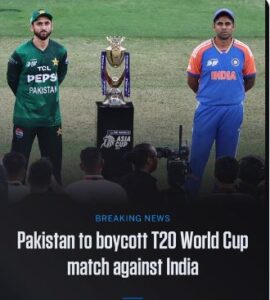
In a historic and shocking development, the Government of the Islamic Republic of Pakistan has announced that the Pakistan national cricket team will take part in the ICC Men’s T20 World Cup 2026 — but will not take the field against India in their scheduled match on 15th February 2026 in Colombo, Sri Lanka.
This decision has sent shockwaves through the global cricket community, given the deep emotional, sporting, and commercial significance of India vs Pakistan matches — the most watched fixtures in cricket history.
Official Government Announcement
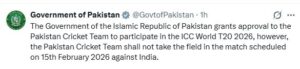
The Government posted on its official X (formerly Twitter) account:
“The Government of the Islamic Republic of Pakistan grants approval to the Pakistan Cricket Team to participate in the ICC World T20 2026, however, the Pakistan Cricket Team shall not take the field in the match scheduled on 15th February 2026 against India.”
This means Pakistan will compete in the majority of its World Cup matches but forfeit its group stage match against India, automatically losing the fixture and the points associated with it.
Why This Decision Happened – Context & Background
🧨 Political & Diplomatic Tensions
The decision comes amid ongoing tensions between Pakistan and India, which often spill into the sporting arena. Recent geopolitical disputes and historical conflicts have repeatedly affected bilateral cricket relations.
While the government’s statement did not specifically list detailed reasons, analysts believe the move is connected to regional diplomatic sensitivities and the controversy surrounding Bangladesh’s exclusion from the tournament after they refused to tour India due to security concerns.
🌍 Solidarity with Bangladesh
Reports suggest Pakistan’s decision shows solidarity with Bangladesh, whose team was replaced by Scotland after refusing to play matches in India over safety fears. Pakistan’s government has implicitly linked its stance to perceptions of “double standards” by tournament organizers.
What Is the Impact on the ICC T20 World Cup 2026?
📊 Tournament Structure
The ICC Men’s T20 World Cup 2026 has 20 teams divided into groups, and Pakistan is placed in Group A with teams including India, the USA, Namibia, and the Netherlands.
By forfeiting the India match, Pakistan will likely:
-
Lose automatic points (India will be awarded points by default).
-
Impact its net run rate (NRR), an important tiebreaker for advancing to the Super 8 stage.
-
Weaken its chances of finishing in a qualifying position for the next round.
Reactions from Cricket Boards & Fans
💬 International Cricket Council (ICC)
There has been no official ICC statement yet on any sanctions or penalties for Pakistan’s decision. If it is seen as a government directive rather than a PCB (Pakistan Cricket Board) choice, the ICC’s ability to punish might be limited.
🏏 Pakistan Cricket Board (PCB)
While the PCB officially supports participation, some former Pakistani players and commentators suggested that skipping only the India match may be used as a political gesture without full withdrawal.
🌍 Fan Reactions
Social media reactions are mixed:
-
Some Pakistani fans applaud the government’s dust-up stance and “solidarity” message.
-
Others criticize the move as damaging to Pakistan’s chances and unfair to players.
Historical Significance of India-Pakistan Matchups
Matches between India and Pakistan are the most watched and commercially valuable in global cricket — often drawing billions of viewers worldwide and generating massive broadcast revenue. Their historic rivalry transcends sport, rooted in decades of political and cultural tensions.
Missing a marquee fixture like a T20 World Cup India-Pakistan match is unprecedented and could impact:
-
Broadcast deals
-
Sponsor interests
-
ICC revenue
-
Global fan engagement
This decision is thus not just sporting but also commercial in impact.
Possible ICC Reactions & Enforcement
If Pakistan continues to refuse to play:
-
The ICC may enforce automatic forfeiture and loss of points.
-
NRR (net run rate) consequences could further jeopardize Pakistan’s chances of reaching the Super 8 stage.
-
ICC regulations generally discourage political interference, but interpretation varies if a government directive is cited.
Pakistan’s World Cup Prospects Now
Pakistan will begin its World Cup campaign with matches against:
-
Netherlands
-
USA
-
Followed by the forfeited India match
-
Namibia
(Pakistan’s schedule per the T20 World Cup fixtures)
Given the complexity:
-
Pakistan now has fewer opportunities to collect points.
-
Their advancement will depend heavily on wins in other group matches and a strong NRR.
This adds competitive pressure on matches against teams like the USA and Namibia.
Political vs Sporting Debate
This episode highlights the intersection of politics and sports:
-
Many argue sports should remain neutral and separate from diplomacy.
-
Others support using sporting platforms to signal political stances.
In this case, Pakistan’s move reflects political dynamics influencing international cricket, reminiscent of past events where cricket schedules were affected by diplomatic relations.
What It Means for Cricket Fans Globally
For international audiences, this means:
-
No India vs Pakistan match in T20 World Cup 2026.
-
Potential changes in TV schedule, ticketing, and sponsorship promotions.
-
Fans of both nations will miss out on the most anticipated fixture in world cricket.
Cricket enthusiasts are closely watching how the ICC responds, including whether it will consider this a one-off or redefine rules for future political intervention.
Conclusion
The Government of Pakistan’s announcement — approving the national team’s participation in the ICC Men’s T20 World Cup 2026 but banning them from playing India on 15th February — is a major turning point in cricket history.
This decision reflects deep political concerns, regional controversies, and solidarity statements, with a direct effect on Pakistan’s tournament strategy and global cricket dynamics. The consequences extend beyond sport, touching diplomatic relations, ICC governance, and fan engagement worldwide.
This story will continue to unfold as the T20 World Cup 2026 approaches, and cricket fans across the globe await official responses from the ICC, BCCI, and PCB
Pingback: ICC Men’s T20 World Cup 2026 Broadcast Guide: Where & How to Watch Every Match Live - SANI SPORTS
Pingback: Pakistan Government Clears Way for India vs Pakistan T20 World Cup 2026 Clash on February 15 - SANI SPORTS